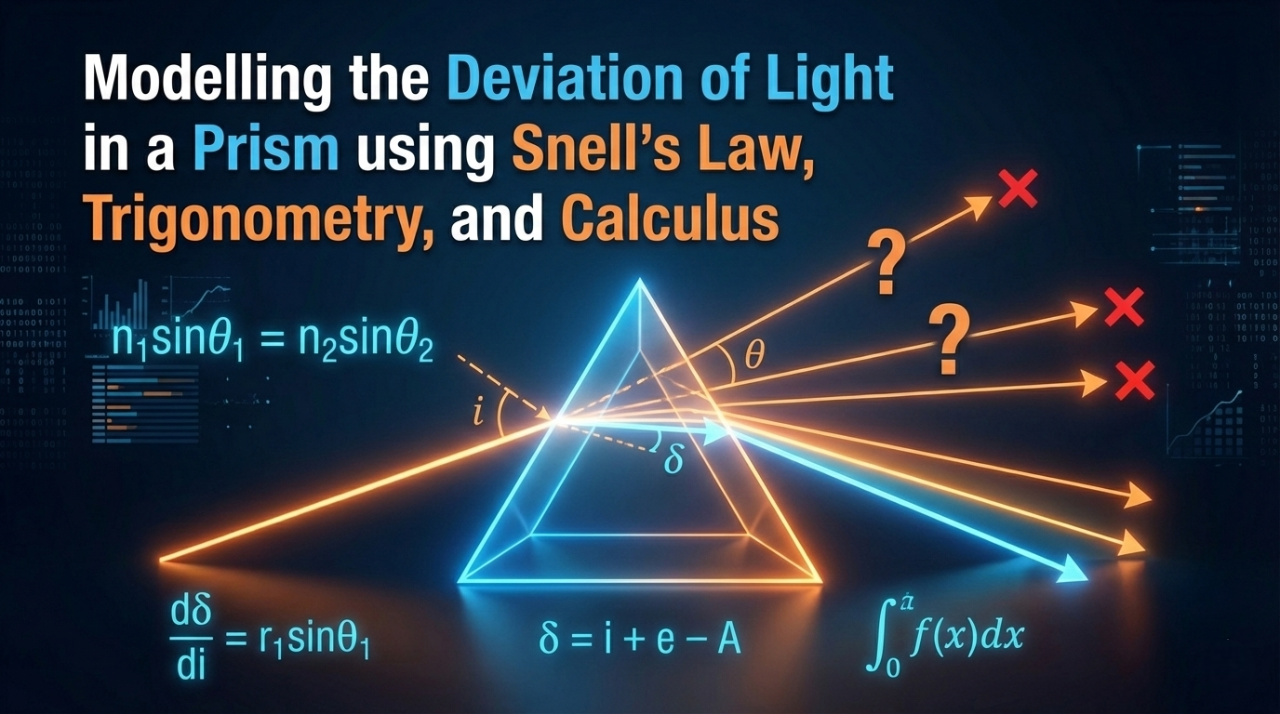
Turn your interest in physics and optics into a rigorous, high‑scoring IB Mathematics AA HL Internal Assessment. This downloadable PDF (Preview – Modelling the Deviation of Light in a Prism using Snell’s Law) gives you a complete, structured planning template to explore how a ray of light is deviated by a triangular prism, using Snell’s law, trigonometry, and calculus to find conditions for minimum deviation.
This is not a finished IA and must not be copied into your IA. It is a guide and structure to help you create your own original work, in your own words.
Who is this for?
- IB Mathematics: Analysis and Approaches (AA) Higher Level students.
- Students who enjoy physics/optics and want to connect it with rigorous mathematics.
- Anyone who wants a clear, well‑structured IA on:
- Snell’s law and refraction,
- Trigonometry and triangle geometry,
- Functions and inverse trig,
- Differentiation and optimisation.
(Strong AA SL students could adapt this template with some adjustments.)
What this product is (and is not)
This product IS:
A PDF planning template that:
- Breaks your IA into clear sections and subsections.
- Tells you what to do in each part (e.g. “define all angles and variables”, “apply Snell’s law at each face”, “differentiate the deviation function”).
- Suggests what maths to use and where (Snell’s law, trig identities, inverse trig, calculus).
- Suggests graphs, tables, and diagrams to include.
- Provides reflection and engagement prompts to help meet IB Criteria C and D.
This product is NOT:
- A completed IA.
- Text you can copy into your IA.
- A substitute for your own thinking, derivations, and writing.
Multiple students may purchase and use this template, just like they can use the same textbook or online guide. Your final IA must still be uniquely yours.
Very important: Academic honesty and originality
To stay within IB academic integrity expectations:
- Do NOT copy any sentences or paragraphs from the template into your IA.
- When the template gives sample or example sentences (e.g. for your aim), you must rephrase them in your own words.
- Use the template to structure and inspire your work, not to produce identical wording.
You must:
- Use your own choices of prism angle A and refractive index n (based on real materials).
- Choose and justify your own modelling decisions (e.g. how you define deviation and valid angle ranges).
- Do your own derivations and calculations.
- Write all explanations, reflections, and interpretations yourself.
If you follow the plan but write everything in your own words and personalise your parameters and choices, your IA remains your original work, even if other students used the same template.
What’s inside the template
A detailed, section‑by‑section guide, including:
1. Introduction
(You must phrase your own aim in your own words; sample phrasing is given only as inspiration.)
2. Setting up the prism model
3. Applying Snell’s law and building angle relationships
4. Constructing the deviation function D(θᵢ)
5. Differentiation and finding the angle of minimum deviation
6. Numerical exploration and graphing
7. Validity checks and physical comparison
8. HL‑level extensions (optional)
9. Conclusion, Limitations, and Reflection
Mathematics level and technology
Designed for AA HL: uses only syllabus‑appropriate tools:
- Trigonometry and inverse trigonometric functions,
- Geometry of triangles and angle relationships,
- Functions and graphing,
- HL‑level differentiation and optimisation with trig and inverse trig.
Technology (GDC/Desmos/GeoGebra) is used sparingly, for:
- Plotting D(θᵢ) and related functions,
- Solving especially messy trigonometric equations numerically.
You are instructed to:
- Show at least one worked example of each type of calculation by hand,
- Always explain what the technology output means in the context of light and prisms.
Additional support (optional, paid)
If you want more than just the template:
- Draft review and feedback – additional $30 or IA Boost for $150
You write your IA draft using this plan. We provide detailed comments on:- Structure and clarity,
- Mathematical reasoning and explanations,
- Personal engagement and reflection,
- Alignment with IB criteria.
You remain the author; we do not edit or rewrite your IA. - In case you choose IA Boost, then in addition to the above, we give you detailed instructions how to improve your IA to score high.